
Clay County Release Date Meanings
Kansas has no single release-date formula. The offense date, sentencing system, severity level, prison portion, concurrent or consecutive terms, jail credit, good-time eligibility, program credit, disciplinary history, parole decision, detainers, and later court orders can all affect the result. A calculator based only on the sentence length would hide those differences.
A pretrial Clay County detainee usually has no projected sentence-release date because the case has not reached a sentence. Bond, dismissal, a plea, trial, a hold from another agency, or a transfer can change custody first. The court docket may show the legal event, while the Clay County Jail's custody record shows when the person physically left. Do not turn a future hearing date into a release date.
For a KDOC prisoner, KASPER uses the confirmed label “Earliest Possible Release Date.” Preserve that wording. Do not rename an earliest possible, parole eligibility, conditional release, maximum, or sentence-begins date as a projected release date. Each term has a different legal role. The actual release may also be release from prison into parole, conditional release, or postrelease supervision rather than final discharge from KDOC.
Find Clay County Projected Dates
Start by determining who holds the person and which court imposed the sentence. The Clay County Sheriff's Office cannot compute a later KDOC sentence, and KASPER cannot supply a date for a person who only served a local jail term. Use the record created by the agency that administers the custody period in question.
- For the Clay County Jail / Clay County Law Enforcement Center, call 785-632-5601 to confirm current custody and whether the matter is pretrial or sentenced.
- Retrieve the Clay County District Court journal entry, sentence, bond order, and jail-credit finding through the Kansas court portal or clerk.
- For a KDOC commitment, open the official KASPER disclaimer, accept it, and search by KDOC number when possible.
- Open the matched record and copy the date's exact label, current status, admission date, current location, and relevant case information.
- When the computation is disputed or unclear, submit a KDOC KORA request for the public sentence computation, release or discharge history, and an explanation of the displayed date.
- Recheck near the date and confirm the actual custody change with the responsible facility or later status record.
The KASPER entry page states the database's coverage, update cycle, and limits before search access.
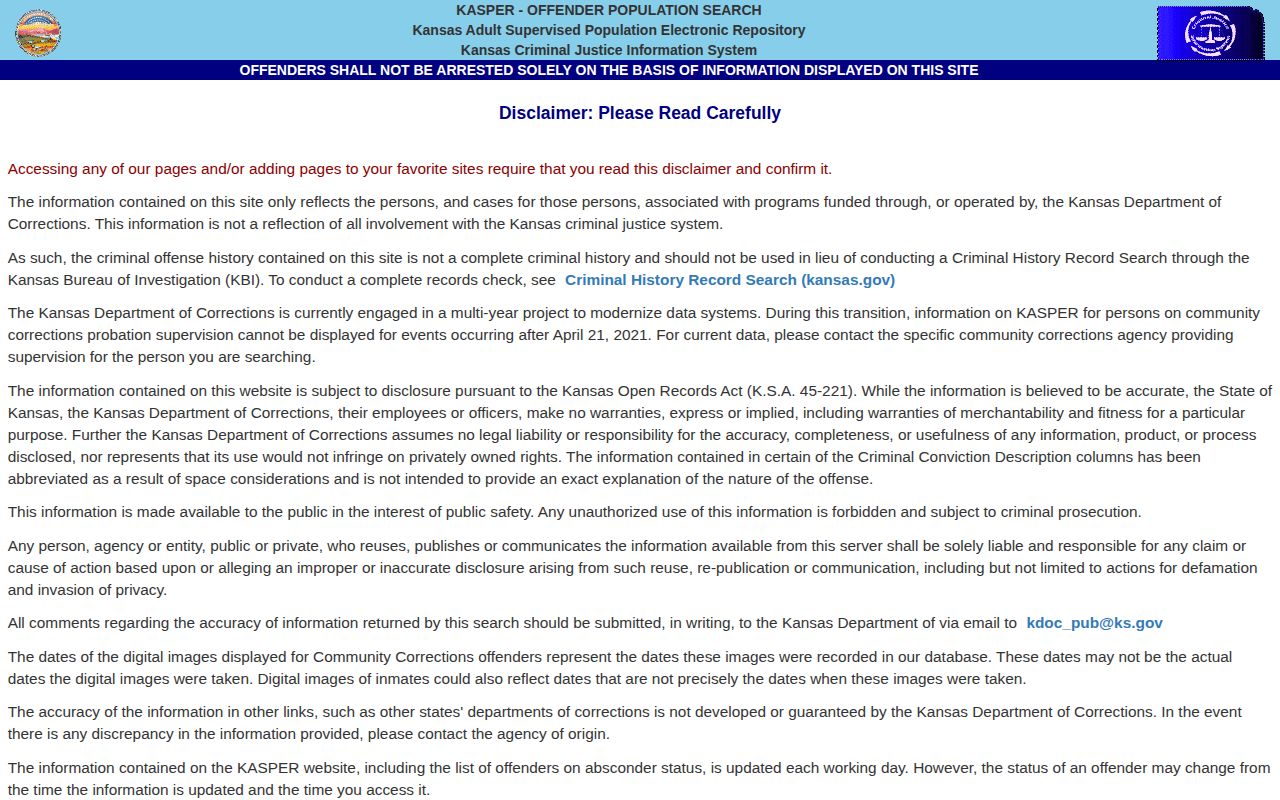
The state portal is appropriate only when KDOC custody or funded supervision is involved. A Clay County-only jail sentence remains a local court and Sheriff records question.
Clay County KASPER Date Fields
KASPER can be searched by name or KDOC number. Its form also supports middle name, aliases, birth date or age range, race, gender, KBI state-identification number, conviction county, parole-supervision county, and photo-display choices. Clay may be used as a conviction county filter, but a Clay conviction does not prove that the person is housed in Clay County or will return there.
After opening the right person, examine the full record. Confirmed headings can include “Current Status reported by Dept. of Corrections,” Current Status, Admission Date, Current Location, Custody Level, and Earliest Possible Release Date. Conviction sections may identify the county, case number, offense and sentencing dates, conviction description, count, severity level, and case status. The planning date must be read beside those facts.
| Record detail | Why it matters |
|---|---|
| Current status and location | Shows whether the person is reported in prison, under community supervision, or discharged |
| Earliest Possible Release Date | Supplies the official public planning label, not proof of actual release |
| Admission and sentence dates | Help identify the sentence period and correct case |
| County and case number | Connect the KDOC entry to the controlling court record |
| Supervision information | Can show that prison release begins continued KDOC authority |
KASPER states that information is updated each working day and can change between updates. Save the access date when documenting a milestone. When formal proof is needed, KDOC's public-record categories may include sentence structure, controlling sentence, anticipated guidelines release, parole eligibility, conditional release, expiration, movement dates, supervising office, and revocations. A targeted request is better than guessing what an abbreviated field means.
Clay County Good-Time Rules
For crimes committed on or after July 1, 1993, K.S.A. 21-6821 generally limits good time subtracted from the prison part to 15 percent. That rule produces the common “serve 85 percent” shorthand. Yet the phrase is incomplete and should never be used as a guaranteed exit date.
Specified lower-severity nondrug crimes committed on or after January 1, 2008 can have a 20 percent limit. Certain drug-grid categories and date ranges also permit 20 percent. Program-credit provisions can apply to some eligible sentences. Credits must be earned, and they may be forfeited, withheld, restored, or recalculated under law and agency rules. Neither 85 percent nor 80 percent resolves the date without the correct offense, severity, dates, sentence structure, and credit record.
For crimes before July 1, 1993, K.S.A. 22-3725 supplies the older good-time table and calculations tied to parole eligibility and conditional release. KDOC explains that under an indeterminate sentence with a minimum of at least two years, full regular good time can make parole eligibility arise at half the minimum. A one-year minimum can reach eligibility after nine months. Eligibility permits Prisoner Review Board consideration. It does not guarantee parole.
K.S.A. 22-3717 provides the main parole and postrelease framework. Older indeterminate cases may require a Board suitability decision, while guidelines cases generally move from the prison portion to a defined postrelease term by sentence computation. Off-grid and specially governed offenses follow distinct rules. A charge name alone cannot support a valid first-eligibility estimate.
Clay County Jail Credit
K.S.A. 21-6615 governs qualifying credit for time incarcerated before disposition and requires the sentence or journal entry to account for that time. The calculation can exclude time already credited to another consecutive case or time spent in another jurisdiction without the relevant hold. Booking date alone therefore cannot establish a prison release date.
County-jail sentences create a separate issue. The sentencing court's journal entry, statutory credit, and the jail's execution of that order control. KDOC good-time rules should not be applied automatically to a sentence that was never committed to KDOC. Research found no published Clay County jail good-time policy and no documented weekend or holiday release policy.
Ask the Sheriff how a specific local order is being carried out and obtain the journal entry from the Clay County District Court. If the court record lists jail credit, compare it with the jail's custody dates. If the person later entered KDOC, use the KDOC computation for that prison term and identify any credited local time from the sentence materials.
Why Clay County Dates Change
A projected or earliest date is a moving administrative milestone. Some changes are favorable, while others move the date later or change the destination without changing the prison exit. Compare the newest agency record with the controlling court papers rather than relying on an old screenshot.
| Change | Possible effect | Record to check |
|---|---|---|
| Credits earned, lost, restored, or recalculated | Moves the sentence computation | KDOC computation or disciplinary credit record |
| Jail credit corrected | Changes credited time | Journal entry and KDOC response |
| Concurrent or consecutive structure amended | Changes how terms combine | Later court order |
| Parole granted, continued, or passed | Changes the possible release path in an eligible older case | PRB process and later KASPER status |
| Detainer or another sentence | May change destination or keep the person in another custody | Agency hold and receiving-custodian record |
| Release to postrelease supervision | Ends prison confinement but not KDOC authority | KASPER status and supervision record |
A detainer is a request or legal hold from another authority. It can cause a transfer when the prison or jail portion ends. That transfer is not release into the community. The receiving county, state, federal, or immigration agency must be checked before describing the person as released.
Parole decisions also require care. The Prisoner Review Board uses the outcomes parole, continue, and pass. Parole means the Board found the person suitable, while continue postpones a decision and pass denies release for a stated period. Even a parole outcome precedes release planning and conditions. The monthly public-comment list shows approaching hearings, not completed releases.
Confirm Clay County Actual Release
Near the expected date, return to the correct live record. For KDOC, compare the Earliest Possible Release Date with current status, location, movement history, and supervision. A parole, conditional-release, or postrelease label may establish departure from prison with supervision still active. A discharged status more strongly supports the end of KDOC authority.
For the Clay County Jail, call the Sheriff's Office and request the custody-event or release record. The court order explains the legal authority, but the jail event shows physical processing. Kansas VINE may provide a faster custody-change notice when the record names the appropriate participating facility. The Clay County VINELink check explains how to match one person and register an alert.
For a federal prisoner, use the BOP locator and read “Released” and “Not in BOP custody” as different terms. The latter can include another custodian. For immigration detention, ICE ODLS is mainly a current locator, so disappearance is not affirmative proof of release. Neither system should be mixed with a Kansas or Clay County computation.
The Clay County release records path shows how to join a jail event, court disposition, KDOC status, and other custody-specific sources. The strongest answer uses the latest agency status plus the record that explains the controlling sentence or order.